Tuesday, October 20, 2020

Can "Community" Come Back?

 Following from yesterday's post, some thoughts on what effect the pandemic is having on our sense of community.

We all know about the major conventions and meetings that have been forced to cancel or postpone or go virtual over the past six months: Comic-Con, the World Science Fiction Convention (which previously had only been cancelled by World War 2). even the American Library Association cancelled its summer gathering. But what about the smaller local groups that have not met in that time?

I'm talking about the dozens of PTA meetings around the country that weren't held; the library book groups put on hold; the church socials, bingo games and fundraisers cancelled. These are events that bind local communities together, that bring neighbors into contact with each other to share time and experiences.

I have a two-fold fear: First, that even when, with any luck next year, those events can be held, the impetus to arrange and run them will have dissipated, that the organizers will say, "We got along without it last year, it's a a lot of work, why not just do something virtual again?" Second, that if the organizers go ahead, will there be enough people who feel safe attending to make it worthwhile?

Are we about to lose another part of American life forever?

Monday, October 19, 2020

Is Voting Better as a Communal Activity?

 I have already voted. I received my ballot in the mail a few weeks ago and dropped it off at my county's drop box last week. I did it because I am concerned about long lines and crowding at the polls on November 3 in the midst of a pandemic.

But now I have been wondering: Absent the special circumstances of this year, are we better off if voting is seen as a communal activity? As something where neighbors and friends must all arrive at the same place (not necessarily at the same time, of course) to cast their votes? To see their fellow citizens all participate in this endeavor, including the ones who volunteer to man the tables at the polling place and to greet voters as they come in and urge support for a particular slate?

If voting becomes one more thing that we do in the privacy of our homes, the way most entertainment has, do we lose a sense of community? Do we lose the idea that we are, indeed, all in this together? Even if you vote for a different candidate than I do, if I see you there, waiting to take your turn to fill out the ballot, do I realize that we are both participating in the governing of our nation, our state, our community? And if I don't, because we are both sitting at home, marking circles on a sheet of paper, sticking it in an envelope and mailing it, have I missed that realization of working and governing together?

I know that some states have been doing 100 percent vote-by-mail for about a decade now. If you live in one of those states, how do you feel about this?


Sunday, October 18, 2020

Suitable for Sunday

 Yesterday afternoon, I was at my church to help at our Pumpkin Patch Fundraiser. It gave me the chance to see the interior of the church in an unusual situation--with all the lights off and the afternoon sun streaming through the big stained glass windows on the west end of the nave. (Like many Episcopal churches, it is aligned with the altar at the east end.)

So I took the opportunity to get this photo. (For the record, it is slightly enhanced to improve the colors from the windows.)


If you'd like to visit in person, it's Christ Church in Ridley Park, PA (Sellers Ave. and Nevins St.). Our pumpkin fundraiser continues to Halloween and the hours are 11-7 Sunday to Friday, 9-7 Saturday.


Saturday, October 17, 2020

Toxic Fandom?


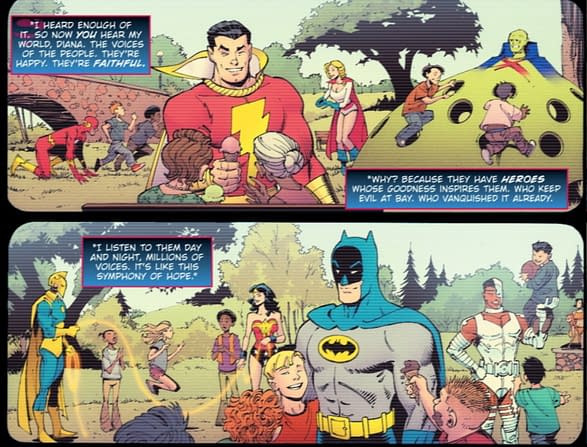
In a commentary on DC Comics' Death Metal #4 on the Bleeding Cool site, Rich Johnston opines that it is an analogy to a "toxic fandom" that wants superhero comics to remain in the vein of the 1960s Silver Age, rather than advance to a more "mature" content.

The funny thing is, I think the "toxic fandom" are those who insist all comics must be written and drawn to their preferences, the adults who grew up reading superhero comics, graduated to other forms, and now want the characters of their youth to match their outlook. Trouble is, those characters were never meant to appeal to adults, other than as an escape from the real world, not as a reflection of it.

To want Superman or Batman or the Flash to be characters who deal in real-world adult problems, to be dark, grim, humorless is like wanting any other character originally aimed at youngsters, like, say, Doctor Dolittle, to mature along with its readership, so that now Hugh Lofting's gentle veterinarian is an organizer and protestor for PETA. All the joy, all the whimsy, all the fantasy is ejected in favor of dark realism--a world of "talk to the animals" overlayed with the horror of animals used to test cosmetics.

Yes, some stories aimed at kids grow with them. J.K. Rowling's Harry Potter series is a prime example--but the early books, with their more light-hearted approach, still remain for a new generation to start with and then progress into the later, darker, adventures. But the advocates of a "mature" superhero genre don't want their "realistic" heroes to be tainted by the existence of the versions aimed at a younger audience--or simply a readership that prefers a simpler, more classically heroic set of characters.

The proof that these readers are the true "toxic fandom"? Look at what has happened to sales of comics in the three decades since the publishers began catering to them.


Friday, October 16, 2020

All Politics is Local

 As I turned on the TV this morning to reports of the "dueling town halls" last night, a thought occurred to me: All the concentration on this admittedly crucial Presidential election is draining attention from state and local contests--and, in the long run, those could be far more consequential.

There's only one state-wide race in my area--for state attorney general. (Neither of our Senators is up for re-election this cycle.) While normally a state AG is not big deal, in the litigious world of modern politics, having an AG who supports voter rights can be very important.

The entire state legislature is up for grabs this year...and, if your local state reps are in play, you should pay attention--especially this year. The people we put in our state legislatures in this election will decide the state and congressional districting following the 2020 Census. Republicans have, over the past two decades, used that decennial process to skew representation toward their strongholds in the states where they control the legislature. As an example, here in PA, Democrats outnumber Republicans in the electorate by just under one million in a total of just under nine million voters; yet the legislature is controlled by the GOP: 109-93 in the House, 28-21 (with one independent) in the Senate.

And the Congressional delegation is also out of balance: 10 Republicans, 8 Democrats in the House; one Senator of each party. 

So, don't let the Presidential race be the only thing on your mind as you fill out your ballot or go to the polls.


Thursday, October 15, 2020

Town Halls

 I do not plan on watching either of the town halls tonight. For those who have been in a cave for the past 48 hours, Joe Biden will have a town hall on ABC tonight at 8PM Eastern time; President Trump will have one on NBC at the same time.

I've never thought town halls were useful in the best of times (and these are decidedly not the best of times). The questions are never well focused and it's way too easy for the candidates to fudge around the edges for an answer (yes--even worse than they do in a regular debate). But I think it might be interesting to see Trump's head explode when he realizes that some of these ordinary citizens will not be lobbing soft-balls at him. In the alleged town halls he has done in the past, the questioners have been chosen by his own staff and have consisted of his supporters. This time, I assume, NBC News will be picking the questioners and will be trying for a good mix of Trumpists, Biden-supporters, and undecideds (hopefully more of the last than anything).

Are you watching?

Wednesday, October 14, 2020

Browsing the Shelves

 Do you miss bookstores? That is, real brick-and-mortar stores with lots of shelves and lots of books on them in all sorts of categories? I do.

Sure, I can order any book I want (practically) from Amazon...and I do. But first I have to know I want it. There's the rub. Despite the so-called "decline of print," there are literally thousands of books published every year that I may have no idea exist. Their authors do not make appearances on TV, they are not advertised on television, they don't even get reviewed (the idea of every newspaper having a weekly book review column is long gone).

That is why I miss bookstores. I used to wander through the store, browsing the shelves in the sections that interest me....and that's not just science-fiction, comics and entertainment. It includes history, politics, and science. I would frequently see a title and pull it from the shelf, read the back cover or inside flap description, sometimes read the introduction or first chapter and decide "This is interesting," and buy the book. Did I always end up enjoying it? No...but more times than not, I did. A lot of these books never made it to my "permanent collection"--but they added to my knowledge, my core of information.

There's no real way to do that in an on-line environment. Sure you can ask Amazon to show you everything in print about, say, "American history 1850-1900," but the results will be so broad as to be useless (and sometimes the algorithm interprets your request in odd ways).  And even that isn't the equivalent of browsing, any more than ordering your groceries on line is the same as going to the market, seeing a nice piece of meat and saying, "Gee, I haven't had a roast in weeks."

We need bookstores back.


Tuesday, October 13, 2020

That's Not How This Works....

 ...that's not how any of this works....

Remember that line from a series of commercials a year or so back? That's what I want to say every time I hear President Trump bloviate on his "recovery" from COVID. "I'm immune, now"; "If I came through it, anyone can...." and on and on.

I'm not even convinced he's no longer contagious. I'm certainly not convinced he's completely recovered, not when I observe people I know who were far healthier than he before they came down with it. Most still have lingering effects--some lethargy, some difficulty breathing. Hell, I have those lingering effects for days after a bad cold.

I understand the political reasons for wanting to appear completely healthy--but that can be accomplished without the risks the president is taking with his own health and that of all those around him.

Monday, October 12, 2020

"This Ain't No Library"....Oh, Wait, Yes It Is

 My buddy Mark Evanier, on his blog, related this story about his youthful experiences in the public library...and it is very much like my own.

Like Mark, I was an avid reader at a young age and quickly worked my way through virtually everything of interest in the children's section of my local library (the Port Richmond branch on Staten Island, NY). Like Mark, I read all the Freddy the Pig books...unlike Mark, I really enjoyed them. I also went through Doctor Dolittle. And anything they had in science fiction for kids.

Trouble is, there wasn't a lot of that last genre. Even the "young adult" novels of Robert Heinlein and the Lucky Star series by Isaac Asimov were aimed at sixth-to-eighth-graders...and I was ready for them in fourth grade. I was always three-to-four grade levels ahead in reading...and I read pretty quickly, too. So, by the time I was ten or so, my mother prevailed upon the librarian to upgrade me to the adult section. In fact, the children's librarian actually approached Mom about it first, as I recall, because she knew I had exhausted the material under her care.

Of course, that opened the door to more than just SF. I also had (and still have) an interest in paleontology (like most kids, it started with dinosaurs) and I soon found the section for that in the adult room as well.

Anyone else have a library story to tell?

Sunday, October 11, 2020

Re-United?

 Have you ever gone to a class reunion? I have not.

The 50th year reunion of my high school graduating class was last year. I might have gone, but thinking it over decided it would be a waste...on several levels. I was not popular in my high school and I have not kept in touch with anyone I went to school with. Even when I have encountered them on Facebook (there's a group for people from my hometown), we simply acknowledge each other and then move on. I am not even FB friends with any of them. In addition, my high school was, by some standards, quite large: There were about 500 people in my graduating class; I knew perhaps a quarter of them by face and far fewer by name. I never went to the popular "hang out" spots. 

The 50th year reunion of my college graduating class will be 2024. I am even more unlikely to attend that one. If my high school class was large, my college class was enormous. My closest associates and acquaintances would be the couple of dozen people from the campus radio station...and there's no guarantee any of them would be there. In addition, I didn't finish in May; I finished in January. So, am I part of the 1973 class? Or the 1974 class?

I fear either occasion would be much like the high school dances I sometimes attended. I would be standing against the wall, watching everyone else enjoy themselves.


Saturday, October 10, 2020

Tele-Impromptu

 Of all the criticisms currently laid against politicians, "He uses a teleprompter!" is, I think, the most ridiculous.

Every president since Kennedy has used a teleprompter (or similar early technology) when delivering a speech, especially if it is being televised. Most politicians have used one at least since the 1970s. Before that, they read from paper scripts or notes. Abraham Lincoln didn't deliver the Gettysburg Address "off the cuff"--he read it from the back of the envelope on which he had written it on the way to the event.

The criticism is related, I guess, to the idea that a politician should be able to articulate complicated programs or responses to multi-level questions without the aid of notes and on the spur of the moment. The slightest hesitation in formulating an answer leads to the cry, "He can't speak without a teleprompter!" But even the most skilled of orators cannot do that--nor should they. 

Taking a moment to put your thoughts into coherent sentences should be encouraged. Without that, you get the sort of "word salad" for which President Trump is rightly criticized--because he doesn't give himself the opportunity to think before he speaks. I guess he thinks that makes him look weak or unintelligent. But it doesn't...it makes him look like he has considered the question before he answers it.

One more thing: There's nothing wrong with "Let me get back to you on that," as the response to a question you aren't prepared for--so long as you actually do get back to the questioner with an answer within a reasonable period of time (and, depending on the question, a reasonable period can be as long as 24 hours). And "I don't know" is an equally acceptable answer--again, if you research and find an answer in a reasonable time. No one can know everything--though we often seem to expect our elected officials and prospective elected official to do just that, and without the aid of notes or expert advice.

Think about it: What's something you do everyday in your job? Can you explain it to someone else without taking, say, 10 seconds to put your thoughts in order? Why would you expect a politician to explain, for example, a health-care plan in a few words on a moment's notice?

Friday, October 09, 2020

Mis-Remembered

 Looking back, it occurs to me the second Marvel comic book I bought was not Avengers #20 as I said in this post two days ago, but was probably this one:


Amazing Spider-Man Annual #2, 1965. It not only gave me my first real look at Spidey, but also Dr. Strange and the incredible art of Steve Ditko, so very different from the work of Curt Swan, Carmine Infantino, Gil Kane, and the other regulars at DC Comics.

Memory is a funny thing, isn't it?


Thursday, October 08, 2020

The Fly Wins

 To be honest, because I tuned in about 40 minutes late, I missed the fly. But the video and comments are right on. 

Pence's strategy was slightly different from Trump's. He interrupted Harris, but not as much or in the same way Trump interrupted Biden. He was overall quieter and more contained, but he still acted as though he was annoyed that he even had to be there. "Who is this woman who thinks she should have my job?" seemed to be the question in his head.

And, of course, he went over his time--every single time. And not just to finish his sentence or his thought (I'm always willing to let someone do that). He often started on a new tangent as the moderator tried to stop him...in fact, he acted like he couldn't even hear her. Add in that, not once in the 45 minutes or so I watched, did he really answer the question he was asked, but rather resorted to talking points, deflections, and challenges to his opponent, and his presence perhaps really was unnecessary.

Harris had her own moments of obfuscation, of course...every politician will. But she usually at least began by answering the question before heading off to talk about what she wanted to talk about. In my memory, Pence never did--even when a direct answer would have helped his cause. I think, overall, his strategy was "run out the clock."

Just announced this morning that the Presidential debate next week will be handled virtually with the candidates in separate locations and the moderator and town hall participants in yet a third place. I wonder if they will now give the moderator the ability to mute the candidates. (I almost think they have to...anyone who has ever been in a Zoom or similar meeting knows it's like a speaker phone conference--you can't all talk at once.)

Update: I should have seen this coming. Trump says he will not participate in the debate if it's held on-line.

“I’m not going to do a virtual debate,” Trump, who was diagnosed last week with the coronavirus, said in an interview on Fox Business, claiming the Commission on Presidential Debates is “trying to protect” Democratic nominee Joe Biden.

“I’m not going to waste my time with a virtual debate. That’s not what debating is all about. You sit behind a computer and do a debate, that is ridiculous,” Trump continued. He indicated that his campaign was not informed of the decision before it was announced.

His campaign manager, Bill Stepien, added "We’ll pass on this sad excuse to bail out Joe Biden and do a rally instead.”

https://thehill.com/homenews/campaign/520148-trump-says-he-will-not-participate-in-virtual-presidential-debate

Wednesday, October 07, 2020

Comic Book Memories 2

 In the early and mid-1960s, it seems that Marvel Comics had very poor circulation in my area of Staten Island, NY. (All our magazine circulation came through a New Jersey company called Hudson News, which was widely rumored to be "mobbed up"--not surprising as most newsstand circulation in the New York area probably was.) So I rarely saw a Marvel title in the local candy store where I bought my comics.

The first one I have a clear memory of buying is this one:


Strange Tales #112, October 1963--not sure why it caught my eye, especially. The internal art, however, intrigued me with its images of the Human Torch leaving a trail of flame as he flew around. It would be months before (actually a year or more, I guess) before I saw (or at least was attracted by) another Marvel title.

That was this one:


Avengers #28, September 1965. I suspect it was the image of the hero (I barely knew who Captain America was, at the time) hurtling to his doom that struck me...and I wanted to see how they got him out of it. Once I read it, I was very interested in the group dynamics of this quartet of heroes and the art by Don Heck and Wally Wood was compelling. 

By this time, Marvel's availability in my area was much improved, and I was able to follow the Avengers, the X-Men (my two favorite titles of the period), the FF (getting in just as the Inhumans, Galactus and the Silver Surfer debuted), and Spider-Man (the tail end of Ditko's run).

I still followed the DC titles I fell in love with as well--JLA and Green Lantern and the Legion of Super-Heroes, especially. I was officially a comic-book fan, by the age of 13.


Tuesday, October 06, 2020

Comic Book Memories

 Taking a break from discussing politics (thankfully)....


That's the cover of the first comic book I can remember buying on my own--Justice League of America #4, May 1961. What makes it even more memorable is the way I bought it...not at a newsstand or corner candy store, but in my school library. In 1961, I was 9 years old, so I must have been in fourth grade. The school library held a used book sale, to which the students contributed. Someone, I don't know who, brought this one issue of JLA in. I was intrigued by the cover; I knew Superman well from TV and recognized the other heroes from seeing their titles on the stands--but I had not seen them together before. I bought it (I think it was a quarter). 

I have a copy of JLA #4 now...but not this one. I was not a "collector" in 1961...I don't know what I did with this copy of the issue, but it disappeared before I began collecting for real about five years later.

In the near future, I'll tell the tale of the first Marvel comic book I recall buying.


Monday, October 05, 2020

The Infected President 2

 Although there's definitely a cover-up going on as to the severity of President Trump's illness, I do not believe--as some do--that the whole thing is, to use one of the President's favorite words, a hoax.

Why? Because there are just too many people--most of them outside Trump's circle of White House advisers and toadies--who would have to be "read into" the story for it to be a conspiracy to halt the debates and save the President from embarrassment. Once he was transferred to Walter Reed, it would have required that dozens of nurses, orderlies, technicians, and doctors--many of whom are military officers--be told to lie or obfuscate about what is, quite clearly, a national security issue.

There's no way to make that work--the organizers of the false narrative could never be sure that all of those people would do as they were told, in part because it would violate their oaths as military personnel. There's a lot of fiction written about military officers who act in violation of the honor code (A Few Good Men, anyone?), but my experience is that those officers are few and far between, especially if the given reason for doing so is purely political. They might do it to protect the people they serve with, but not to advance the political objectives of a civilian.

Is somebody--including possibly the President's chief physician--not giving us the whole story? Undoubtedly. But is the core of the story--that President Trump has tested positive for COVID-19 and requires hospitalization--a lie? No.


Sunday, October 04, 2020

No Politics Zone 2

 Well, I pretty much managed to meet my goal. I was on Facebook yesterday, but I studiously avoided anything political. I missed the evening news because I was on Zoom with friends. I read the paper this morning and watched a little of MSNBC and that largely caught me up. Nothing's changed in 24 hours of any consequence.

Tomorrow, I will return to my usual routine of FB and news. With less than a month until election day, I don't think it's wise to completely shut myself off from what's happening in the world. There could be yet another "October Surprise"...or events overseas that upset the applecart here as well. 

On the other hand, I'm far more rested and peaceful this morning than I was on Friday...and that's a good thing.


Saturday, October 03, 2020

No Politics Zone

 Time to avoid politics, at least for a day.

So, how do I do that? Well, I'm going to stay off Facebook for the most part, save for the occasional scan for replies to this posting or to other postings or comments I've made in the past few days. I'm scheduled for Zoom get-together with friends this evening, where I hope politics won't come up.

I turned off MSNBC after an hour, once it was clear there was no news on the President's condition--but a lot of news on others in his circle who have tested positive in the past 48 hours. Looks like his events since last weekend have all been spreaders of the infection.

How do you avoid politics when you feel the need?

Friday, October 02, 2020

The Infected President

 Okay, so now what?

I have to admit when I heard this morning that President Trump announced (by tweet, of course) that he and the First Lady had tested positive for COVID-19, my first thought was "This is how he gets out of doing any more debates." On further reflection and on hearing more detailed reports (such as that he probably got it from adviser Hope Hicks), I decided it wasn't just a ploy. I am still concerned about how he will use this politically.

Certainly, if he comes out of it quicker than most, he will announce something like "I am the healthiest President in history." More problematic is if he does not fully recover within the quarantine period and decides to go back into the public anyway--probably never letting anyone know he is not fully recovered. This is a man whose only concern is his own public persona, his intense desire not to look like a "loser"...and that will lead him to try to project a "strong man" image.

What does it do to the campaign in general? Well, for at least the next 10 to 14 days, no massive Trump rallies and a lot less of Trump himself on television. And the Biden campaign? A lot will depend on how his COVID tests turn out (I'm assuming he got one as soon as he heard Trump was positive). Even if he's negative, I'd assume he will cut back on some of his travel and meetings, in an abundance of caution.

For both sides, this is not the "October surprise" they were expecting.

Thursday, October 01, 2020

What Should Pollsters Ask?

 Maybe there's a question pollsters should ask more often: "What is your primary criterion for choosing a candidate to vote for?" Remember during the 2000 campaign, Bush-Gore, when people were known to say, "I like George Bush because he seems like somebody I could sit and have a beer with"? Is likeability the primary reason you vote for someone? Is the candidate's seeming resemblance to you and your life a primary factor? I recall saying, in response to this kind of answer, "I'm choosing a President, not my best friend."

On the other hand, having a sense that the candidate understands what my life is like--whether he has ever lived that way or not--is, to my mind, a reasonable criterion. Yes, no one who was able to go to an Ivy League school will ever be able to claim he or she has lived something like my life...but from the way they speak, from the people they associate with, from the positions they espouse, I can still say, "That person understands my circumstances."

And that takes us to policy. There's a meme going around that voting is like public transportation. You pick the bus or train to take based on which one will get you closest to your destination; you don't stand around waiting for the one that will take you door-to-door, because that rarely occurs. I don't expect any candidate to agree with me on everything. I don't even expect perfect agreement on the most important things. I expect that the candidate I choose, like the bus I choose, is traveling in the same direction I am. He may end the trip before I reach my destination, or I may get off before he reaches the end of his line, but he's at least getting me closer to my goal than I am now.

Finally, I--and the candidate--must be willing to accept that half-a-loaf is better than none. OK--we won't get, for instance, universal health care this go-round. But can we reach a deal that gives a significant number of people health care who do not have it now...and then work to expand that number in the future? Refusing to take the half-step because it's not the full step only leaves us where we are.