Showing posts with label superheroes. Show all posts

Friday, March 19, 2021

Super-Story Telling

 A frequent complaint about Superman is "he's just too powerful, you can't confront him with a credible threat." I think the first four episodes of Superman and Lois put that argument to rest.

How? Well, not by putting him in physical danger...and that shouldn't be the point, anyway. A good superhero story (any superhero, not just Superman) isn't about how he uses his extraordinary abilities to defeat the bad guy (we all know he's going to do that), it's about how he does that and maintains his humanity and his real life. So far, in S&L, the super-powered battles have been a clothesline upon which to hand the far more interesting human conflicts faced by the Man of Steel and his family.\

Spoilers ahead.

Two scenes in the latest episode, "Haywire," demonstrate that. First, there's the confrontation between Clark and Lois over his failure to appear at the town council meeting (because he was summoned to fight Killgrave). Lois knows Clark is right...and Clark knows that doesn't matter, because he broke a promise on something very important to his wife--and maybe to their whole community. 

Second is the confrontation between Clark and Sam Lane over the conflict between parenting and being a hero. Watch as Clark stands his ground and makes Sam back down--not by a physical threat but by the force of his moral argument. Sam put duty before family and was, frankly, a lousy husband and father, whose daughter resents what that choice meant to her growing up. Clark knows he can do better--and will.

And all this comes while still telling a satisfying action-adventure story.


Saturday, January 30, 2021

Chasing WandaVision 2

 OK, I'm caught up through episode 4 and at least they're trying to explain what's going on. That's better--but this is still, IMO, a seriously flawed series.

Let's start with the basic concept (SPOILER ALERT!)--Wanda is doing all this in an attempt to deal with her despair at the loss of both her brother and her lover, creating a perfect fantasy life. Sure; but why does a woman in her 20s, raised in Eastern Europe, base her image of perfect married life on the American sitcoms of the 1950s-70s, that I assume--given her background--she never saw until she came to the United States as an adult? Further, why didn't she just pick one, instead of advancing from the 1950s to the '70s? (Of course, the answer to that, from outside the world of the series, is that the writers and producers wanted to hit as many iconic shows as they could.) And, if she continues, what will she emulate when she gets to the 1980s? Family Ties? Married with Children?

Now let's get to the real problem--it's taken four half-hour episodes (the time equivalent of a full-length movie) to reach the point where the story is explained to the audience. Tell me, would you sit through a movie or a stage production that took that much time to make sense? I wouldn't. I'm all for a mystery...but at some point, at least the bare outlines of the story have to be made clear so the final resolution of the mystery is understandable.

I'll keep watching--but probably two episodes at a time--in the hope the pace picks up.


Friday, January 29, 2021

Thoughts on Heroes

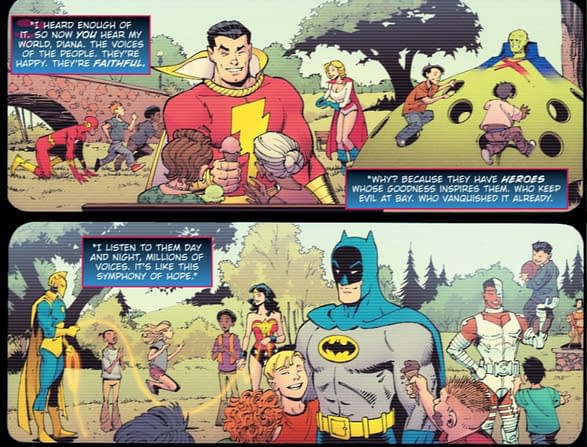
 What makes a hero? Specifically, what makes a superhero? Extraordinary abilities, obviously...but some superheroes--notably Batman and Robin--have no superpowers; their extraordinariness comes from training and study.

But I think there has to be something more than that. I have always been drawn to the characters who would have been heroic before they gained superpowers or put on a tight-fitting suit. Prime example is the original version of the 1960s Green Lantern: Hal Jordan. Jordan was a test pilot before he met the alien who handed him a glowing lantern and a ring. If you read the accounts of his past as they were revealed, he was to all extents the DC Universe equivalent of Neil Armstrong. Had that fateful meeting not put him on a different path, he might well have been one of his world's Mercury astronauts. He was already a hero.

Similarly, because of the way he was raised by his foster parents, Clark Kent might have been a hero even if his alien origins didn't give him superpowers. In some ways, even when he wasn't flying around dressed in red-and-blue, he was: Reporters take risks, put themselves in danger as part of their jobs. Clark was dedicated to helping his neighbors--he didn't need a cape to do it.

I don't feel the same way about Batman, at least not as he is characterized today. In the 1950s and '60s, I did. In those days, Bruce Wayne, having exorcised his own demons, set about to protect everyone else. Today, it seems as if he is still all-consumed by those demons, viewing the world as bleak and corrupt, barely worth saving, except as doing so eases his own soul. That seems incredibly narcissistic to me.

I'll always prefer the hero who can smile when his job is well done.


Saturday, October 17, 2020

Toxic Fandom?


In a commentary on DC Comics' Death Metal #4 on the Bleeding Cool site, Rich Johnston opines that it is an analogy to a "toxic fandom" that wants superhero comics to remain in the vein of the 1960s Silver Age, rather than advance to a more "mature" content.

The funny thing is, I think the "toxic fandom" are those who insist all comics must be written and drawn to their preferences, the adults who grew up reading superhero comics, graduated to other forms, and now want the characters of their youth to match their outlook. Trouble is, those characters were never meant to appeal to adults, other than as an escape from the real world, not as a reflection of it.

To want Superman or Batman or the Flash to be characters who deal in real-world adult problems, to be dark, grim, humorless is like wanting any other character originally aimed at youngsters, like, say, Doctor Dolittle, to mature along with its readership, so that now Hugh Lofting's gentle veterinarian is an organizer and protestor for PETA. All the joy, all the whimsy, all the fantasy is ejected in favor of dark realism--a world of "talk to the animals" overlayed with the horror of animals used to test cosmetics.

Yes, some stories aimed at kids grow with them. J.K. Rowling's Harry Potter series is a prime example--but the early books, with their more light-hearted approach, still remain for a new generation to start with and then progress into the later, darker, adventures. But the advocates of a "mature" superhero genre don't want their "realistic" heroes to be tainted by the existence of the versions aimed at a younger audience--or simply a readership that prefers a simpler, more classically heroic set of characters.

The proof that these readers are the true "toxic fandom"? Look at what has happened to sales of comics in the three decades since the publishers began catering to them.